Blackfriars' Marketing

Thursday, September 27, 2007

Amazon's music store should dispell the lousy iTunes business myth

fig3-2-small.jpg


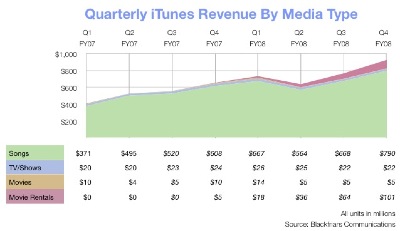
[Blackfriars projections of FY07-08 iTunes Store revenue. Click the image for a larger view, excerpted from our June report, Analyzing Apple: Waiting For The iPhone]


In a recent article, John Gruber of Daring Fireball takes on the launch of the Amazon music download store and dispells one of my favorite media falsehoods: that the iTunes Store is a loss-leading business


"So why Amazon is even bothering with a music download store, given that ‘everyone knows’ the iTunes Store is a loss-leader that Apple offers just to sell more iPods?

Because that’s bull****. Apple is making good money from the iTunes Store.


John estimates gross margin from iTunes at about $900 million from the 3 billion songs sold at the iTunes store to date. Our estimate just for FY07, which ends September 30, 2007 is that iTunes revenue just in this fiscal year is $2.1 billion, with gross margin of $630 million just in this fiscal year.

Just to put those numbers in perspective, it was only about three or four years ago that $600 million was a respectable gross margin number for Apple's entire business, Macs to iPods. And the $630 million in gross margin from the iTunes Store this year is about 1/4 of Amazon's gross profit for its entire business.

And the whole, "Amazon's DRM-free MP3s will give it an advantage over Apple's DRM-laden music," doesn't play either. 95% of consumers never experience Apple's DRM in any way shape or manner. They buy their music from the iTunes store, load them on their iPods, play them on their computers, and never give DRM a second thought. The convenience of one-stop impulse shopping from their iTunes music player vastly outweighs the lower prices and DRM-less features of the Amazon store. Further, Apple itself sells DRM-free music and will increasingly benefit from Amazon's negotiations for that format. So while that vocal minority of music purists who insist on DRM-free music may flock to Amazon's new store, they will only be helping Apple maintain its music dominance with the vast majority iPod owners and music buyers.

The bottom line: Amazon's new MP3 store is great for everyone, and it lends choice to the digital music business. But don't make the mistake of thinking that Amazon's music business threatens iTunes dominance. Amazon's music business will simply will put pressure on music labels to reduce their cut of the digital music distribution pie (since Amazon is undercutting Apple in price and can't do that indefinitely) while expanding choices for consumers. Meanwhile, the vast majority of consumers will continue one-stop shopping for their music, movies and TV shows in Apple's iTunes, preferring convenience over low-prices. Amazon will fight for the number two spot in digital downloads, while Apple's iTunes business will dominate digital music downloads -- and profits -- for years to come.


Technorati Tags:
, , , , ,


Labels: , , , ,

Friday, September 21, 2007

Not to be outdone, the Zune gets a price cut and an apology to boot

small-woot-zune.jpg


After writing about the strategy and marketing behind Apple's iPhone price cut to $399 yesterday, I was most amused to see Woot imitating Apple with a price cut on the Microsoft Zune to $129. It's a one-day only deal, so I've captured the image up above. But considering that even a refurbished previous generation 30-Gigabyte iPod (Apple no longer makes a disk-based iPod that small) will set you back $200, it certainly demonstrates that the dollar value difference between Apple's and Microsoft's marketing skills.

But note I didn't say Woot's marketing skills, because Larry Stalin's apology letter accompanying the price cut (and lampooning Steve Jobs) is literally priceless. Here are some excerpts.

Second, I am sure that we are making the correct decision to lower the price of the 30GB Zune from $149.99 to $129.99. This confidence is based on more than the holy doctrine of corporate infallibility. The Zune is a breakthrough product, and we have the chance to “ride the lightning” and “shoot the curl” this holiday season, not to mention “kill the messenger” and “rock the vote”, further enabling us to “pay the rent” and “keep the lights on”. It benefits both Woot and every Zune user (but especially Woot) to drag as many new victims as possible into the Zune “dungeon”. We strongly believe that misery loves company this holiday season.

Third, being in technology for 1+ years, give or take a year, I can attest to the fact that the technology road is bumpy. There is always some idiot changing lanes without signaling, and the potholes never seem to get fixed. If you always wait for the next price cut or to buy the new improved model, you’ll never buy any technology product. I mean, why should you? Truth is, you don’t really need any of this junk. We’re afraid you’ll catch on to that fact and overpaid frauds like me will have to go back into fields like telemarketing and burrito construction. Fortunately, most of you continue to languish in a consumerist stupor, wallets spread wide for us to plunder as we please. The bad news for us is that if you buy products from companies that support them well, you will receive years of useful and satisfying service. But we’re hoping you’ll buy from Woot instead.

I have to say, Larry's pitch was so entertaining and funny, I was sorely tempted to buy one just to reward the guy for his creativity. Larry's proven ability to convert someone who has no interest in a product into a prospect demonstrates that he has a very bright future ahead in either comedy writing or marketing. I hope he sticks with marketing. It might pay better, and we need the laughs.


Technorati Tags:
, , , , , , ,


Labels: , , , ,

Memo to Steve Jobs: fix these customer issues before they fester

I may be an Apple fan, but I do think that Jeremy Horowitz over at iLounge.com has brought up four legitimate customer issues Apple should fix. I attribute these issues -- defective iPod touch screens that Apple charges a restocking fee to take back, "Made for iPod" accessories that Apple broke with the new iPods, et cetera -- more to neglect than malice, but that doesn't mean that Apple can ignore them.

Apple needs to get a customer-advocacy SWAT team together and make these customers happy again. A happy customer will tell their friends about their experience, but ones that feel they've been wronged will tell everyone they know -- and that just erodes all the brand work Apple has done over the past decade. And if it means another apology from Steve Jobs, so be it. Apologies are always better than lost customers, regardless of whether you are a $25 billion company or a Mom and Pop shop.


Technorati Tags:
, , , , , , , , ,


Labels: , , , , , ,

Thursday, September 20, 2007

The gutsy marketing and strategy behind Apple's iPhone price cut

97C2D421-31AC-4837-BDA7-61F1B1F5294C.jpg


The iPhone price cut appears to be the story that will never die. Leander Kahney at Wired News and I had a great discussion yesterday about the what and why behind the iPhone price cut. Some of what we discussed ended up in the Wired article here, titled, The Perils of Taking the IPhone Mainstream. But there was actually some background and analysis that Leander didn't use, so I thought I would fill in that back story here.

First, here's one of my quotes from the article:

According to Howe, Apple initially priced the 8-GB iPhone at $600 not to milk early adopters, but to purposely constrain demand. While production ramped up at its Asian factories, Apple wanted to restrict buyers to the relative few happy to pay $600 for the phone. Nonetheless, Apple went on to sell a million iPhones in the first two months –- a clear indication of the device's popularity.

Then, as it became clear there was enough factory capacity to produce millions of them in time for the crucial holiday season – when sales explode -- Apple dropped the price to take the gadget mainstream.
With Tuesday's launch of the iPhone in Europe, it's clear that Apple is confident it can satisfy demand in multiple countries.

"(Apple) said they'd like more time before dropping the price," says Howe, "but you can't move the holidays. Clearly, Apple's gearing up for a big holiday season."


Apple has good reason to be gearing up for this holiday season based upon its experience with the iPod. Steve Jobs made an incredibly gutsy call last year in the spring when he told manufacturing to gear up to make more than 20 million iPods to sell over the holidays. Why was it gutsy? Because Apple had never sold more than 14 million iPods in a quarter before. Yet the decision had to be made, and Jobs and his team made it. And it is sounding like Jobs has recently made that same decision with the iPhone by doubling iPhone production for this holiday season too.

But back to the price cut. One London analyst firm has asserted that next year's average selling price for the iPhone will be $200:

"In our projection, we believe there will be about 18 million iPhones sold next year at an average selling price of about $200, and that means a very sizable portion of total handset revenues will move from other manufacturers to Apple. (It) will be in the vicinity of 5 percent that Apple will steal from incumbents."

Not to be outdone, the New York Times asserts that the price might go to zero:

"The iPhone could have an overall impact on the economics of the phone industry. It has put a hardware manufacturer in a highly unusual position of strength relative to the carriers (Verizon, AT&T, etc.). They’re accustomed to calling the shots about what devices get access to their network; not so with the iPhone. It carries its own weight with consumers.

Mr. Saccanaghi, after discussing the issue with various players in the mobile phone ecosystem, estimates that AT&T could afford to pay Apple $15 a month over the lifetime of a two-year contract. That adds up to $360 in payments. And that’s considerably more than the $200 to $350 that AT&T pays other retailers (like Best Buy, Radio Shack) for customer sign ups, Saccanaghi writes.

What does it mean?

Apple could conceivably sell the iPhone hardware at a substantial loss while still generating greater profit per iPhone than it does from the highest-end iPod.

Sounds like a good deal for Apple, with a caveat. If Jobs decides to drop the price of the iPhone, he might consider offering a rebate to existing customers beforehand."


So with production ramped up for the holidays, is Apple going to follow Motorola into the downward price spiral of death?

Oh sure. And it will happen right after Steve Jobs attends an ice skating party in hell with bad Muzak.

What people don't get is that Apple is waging a marketing war to reshape the value chain for the mobile phone industry. Everyone is trying to figure out which trench Apple is occupying, when Jobs is flying in jet fighters for surgical strikes.

Consumers value what they pay for. They don't value things they perceive as free. And that's the marketing blunder the US mobile phone market has bought into over the last 10 to 15 years. By bundling "free" and generic phones with cell phone service, mobile carriers have devalued both the brand values of the handset makers and their own services. The handset makers are hurt because the low values that carriers will pay for free phones eliminates the incentive for those manufacturers to do anything but cut costs. The carriers are hurt because they have to pay subsidy fees to the handset makers of anywhere between $150 and $250 over a two-year contract to actually buy those free handsets. You've heard of a win-win deal? This is a lose-lose deal.

What Apple has done is inverted the value proposition. It has created a phone that consumers see as sexy and desirable, so desirable in fact that they will actually pay $400 to $600 for one (depending on geography). And because the device is desirable, Apple can demand exclusive deals with carriers, which creates valuable differentiation for those carriers that have iPhones and disadvantages for those that don't (yes, I'm talking about you, Verizon and Vodaphone). Because Apple is providing valuable carrier differentiation, Apple can then capture the subsidy revenue stream that the carrier would have normally paid to the handset manufacturers anyway for "free" (and undesirable) phones.

Now, if Apple were to cut the iPhone price to zero, would any of this be happening? Not a chance.

So Apple is going to use its iPod playbook all over again. The original 5 gigabyte iPod went on sale for $399 in 2001. Today, a 16 gigabyte iPod touch sells for -- you guessed it -- $399. Apple chose the price points based on consumer demand and interest. A constant set of features will move down the price scale to more value-oriented price points, but Apple will introduce new and even more desirable products at the old price points. And so long as it can keep that engine going, it will make money hand over fist. And the rest of the handset makers will bang their heads against the wall trying to figure out how they do it.

Don Reisinger at CNET's Crave recently recently asked the question, "Is Steve Jobs really smarter than anyone else?" in this way:


"In the United States, GSM carriers are not the only option, and more often than not, people are willing to go with Verizon Wireless or Sprint Nextel, regardless of the inability to easily switch between the aforementioned companies.

But in the U.K., the economical landscape is much different. In fact, most Britons are more than happy to change carriers and are keenly aware of the terms 'unlocking' and 'SIM cards.' In fact, many people in the U.K. have already purchased an iPhone in the States, brought it home, unlocked it and added it to their own carrier.

Steve Jobs knew that the U.K. is rife with unlocked phones and exclusively GSM coverage. And by looking like the best friend to O2, he's effectively pulling the same trick out of his bag: tell everyone they can only have an iPhone on one carrier, ignore unlocking, take the revenue from O2, and enjoy higher hardware sales due to simple unlocking procedures. Once completed, head to France and Germany, rinse and repeat.

It's amazing to me just how much control one device wields all over the world. Can you think of any other product that could command such respect from a massive cell phone carrier and create a whole new way of doing business in the cell phone industry? I certainly can't.


I can't either. That's because Apple combines award-winning designs with some of the best strategy and marketing in the world. And as long as the press and Apple's competitors keep focusing on the price cuts instead of the strategy and consumer desires, it will continue to reshape the mobile phone industry to its own advantage -- and in the process make its investors a lot more money than anyone wedded to the old mobile phone business expects.

Full disclosure: the author owns Apple stock.


Technorati Tags:
, , , , , , , , ,


Labels: , , , , ,

Monday, September 10, 2007

Apple's secret holiday weapon: the iPod Touch

small-touch-top-amazon.jpg

[Click on the image for a larger version]

Based upon last week's iPhone price cut and some analyst opinions stating we won't see a 3G iPhone this year, Scott Moritz at TheStreet.com today is predicting a "Cold Christmas" for Apple.

Boy, has he ever gotten it wrong.

First, he argues that the iPhone price cut validates a rumor that Apple was cutting iPhone production in half. Yeah right. Economics 101 says that when you lower prices, demand increases. So Apple would cut production why? Heck, my son even bought a refurbished iPhone over the weekend with his own money, so I'd argue that Steve Jobs' goal of bringing more customers to the iPhone for the holidays is all but assured.

But in my opinion, the real reason Moritz has it so wrong is that he ignores Santa's secret weapon that will put Apple's holiday results over the top. That secret weapon is iPod touch. And our analysis says that is going to be huger than huge.

Why do I think that the iPod touch will be such a hit? Because the iPod Touch

  • Already is selling well. The iPod touch is currently the most popular music player on Amazon's list and the #2 top seller in all of Amazon Electronics -- and it isn't shipping yet.

  • Instantly offers world-wide appeal Unlike the iPhone, which requires six month carrier certification and blessing in each country in which it will be offered, the iPod touch is a garden-variety piece of consumer electronics. That means that so long as it doesn't spontaneously burst into flame and complies with all necessary packaging and safety guidelines, it can be sold in almost every country in the world within weeks of it being offered in the US.

  • Can be sold through distribution. Because of its exclusivity carrier relationship, only Apple and AT&T can sell the iPhone in the US, and no one can yet sell the iPhone internationally. But the iPod touch has no such restrictions. iPod touches will be available at Amazon, Target, Best Buy and countless other stores in the US. You'll also be able to buy them in other countries in such varied venues as Dixon's in London, FNAC in Paris, and 7-11 stores throughout Japan.

  • Isn't locked to another company's fortunes. A lot of consumers won't buy an iPhone because they already have a phone with Verizon or Sprint. Or, they may simply know and like their current phone. Or they don't like converged devices. The iPod touch appeals to all these consumer segments that the iPhone doesn't address -- and that makes its available market considerably larger.


So what's our projection for Apple's holiday season? I'll be publishing a detailed analysis in the September Analyzing Apple report (some previous reports are here), but I expect Apple to significantly exceed last year's 21 million iPods sold, and I also expect the average iPod selling price to rise.

There is one open question looming over the iPod touch though, and that's how Apple will recognize the revenue from its sales. Apple amortizes both iPhone and Apple TV revenue over 24 months because of undelivered upgrades to those products, yet normally recognizes iPod sales immediately. Technology-wise, the iPod touch is just like an iPhone and will presumably benefit from many of the same upgrades that happen to the iPhone. And yet, it is an iPod and has no carrier revenue affiliated with it, and therefore, Apple can legitimately recognize the revenue from it immediately, just as it does with other iPods. We probably won't know the answer to this question until the October earnings report, but it will have a significant impact on the holiday forecast.

But regardless of which way the answer turns out, I'm sure TheStreet.com is going to have trouble explaining their forecast of a cold Christmas for Apple come January. They could just blame the miss on global warming. But more likely, it will just be the heat of holiday iPod touch sales.


Technorati Tags:
, , , , , ,


Labels: , , , ,

Wednesday, January 17, 2007

Apple blows out estimates again

UPDATE: Well, for once I overestimated iPod sales, but only as the result of the NPD market share update on January 4. Apple, Inc. reported earnings after the stock market close, and they actually only sold a few more than 21 million iPods (for very large values of only). That's up 50% year over year in units and a 24% increase in revenue. I also missed on computer units, overestimating notebook sales by 300,000 or so. But my biggest surprise was the increase in net margin to over a billion dollars, which rose from 9% of revenues to 14%, causing my estimate of $796 million to look positively gutless.

So what does it all mean? Well, here's a fairly mind-blowing thought: Apple sold nearly one-quarter of the 86 million iPods in the world today just in the fourth quarter. No matter what Business 2.0 asserts, that's not slowing growth. And while we'll undoubtedly see some change in mix with the introduction of the iPhone in very late Q2 (more likely Q3), I wouldn't bet on growth slowing soon. After all, while the iPhone may need a lot of refining to meet FCC and Cingular requirements, Apple has no such restrictions on marketing a WiFi-enabled touch-screen iPod without cell phone capabilities. And the year has just gotten started.

Full disclosure: I own some Apple stock.

Technorati Tags: , , , , , ,

Labels: , , , , , ,

Thursday, January 04, 2007

Apple's marketing may pay off with nearly $8 billion in revenue

Apple iPod ad

One company that hasn't been cutting marketing budgets is Apple Computer, which was named Marketer of the Year over at MediaPost's Marketing Daily. And NPD released some new data today, showing that Apple increased its market share of the MP3 player market from 45% in 2005 to 57.5% in the five weeks around the holiday season in 2006.

Now this data has some notable omissions. Among them are sales from Wal-Mart (a big factor) and the Apple Stores themselves (a huge factor in iPod sales). And the data only covers five weeks, not the entire quarter.

Nonetheless, the data is probably somewhat representative of the quarter, so I did some estimates of the omitted effects. I predict that the Apple stores will be responsible for about 2 million iPod sales on their own, and Walmart will be responsible for another million or so (these numbers are pulled out of the air, so if anyone has better guidance on what I should use for those two estimates, leave me a comment or send me an email). So I plugged it into my model for Apple financials and iPod sales. And below is what I got:


CategoryUnits (in thousands)Revenue (in millions)
Desktops700$976
Portables1,200$1,637
iPods23,000$4,106
Other (Software/iTunes/Periphs)N/A$1,220
TotalN/A$7,938
Net marginN/A$760
EPS (basic)N/A$0.89
EPS (diluted)N/A$0.87


The bottom line: I was a piker in my previous prediction of 20 million iPods and $7 billion in sales for Apple's holiday quarter. Assuming that these numbers are somewhat in line, Apple may see a nearly $8 billion holiday quarter, with $4 billion of that revenue coming from the sales of 23 million iPods.

Full disclosure: I own a small number of Apple shares.


Technorati Tags: , , , , , , , , , ,

Labels: , , , , , , , , ,